How to Increase After-Tax Returns on Investments

How to Increase After-Tax Returns on InvestmentsIt is all about how much you keep after taxes – not what you earn from your job, a business, or investments. While it is always great to see fabulous investment gains, the only financial metric that really matters is what is in your bank account at the end of the day. One of the ways you can influence this is by minimizing the taxes you pay on your investments.

Unfortunately, many people do not think about how taxes impact their investment returns until near the end of the year; however, you should act all year round. Taking part in investment tax planning throughout the year will give you opportunities to keep more of what you earn. Here are some rules and strategies to keep in mind.

Know When to Take Your Losses

Psychologically, many investors are averse to taking losses, holding out to “make their money back.” Instead of emotion, logic and investment acumen needs to be applied here. If an investment does not have a fundamental reason to turn around, then you are better off selling it and taking a tax loss.

Losses reduce taxes on either your capital gains for the year or, when losses exceed gains, up to $3,000 on other income. Excess losses can be carried forward to future years. Plus, you will have the proceeds to reinvest in something more likely to produce a return.

Let Winners Run

Unlike long-term capital gains, short-term capital gains are taxed as ordinary income. This means your marginal income tax rate (the highest rate applied to you) can impact your investment gains.

While you should not let the tax tail wag the investment dog, ideally you want to hold a winning investment for at least a year and a day to benefit from long-term capital gains tax treatment. This means you will pay only a 20 percent maximum tax versus whatever your marginal rate is.

As with losses, the fundamentals of the investment are key. Therefore you should not sell a holding if you think the gains are at risk just to save on taxes. If you believe in the investment for the long term, then holding out for preferred capital gains treatment can be a clever idea.

Give the Gift of Appreciation

Making charitable donations you would not otherwise give is generally not a viable tax strategy. However, if you are already charitably inclined then consider donating stock or mutual funds instead of cash.

When you donate property such as stocks, your charitable deduction is based on the fair market value of the asset on the date of the gift. It is much better to do this than donate cash.

For example, if you have a stock you purchased for $35 and it is now worth $135, when you donate it you will receive a charitable deduction of $135. If you were to sell the stock first, you would have to pay tax on the $100 gains and then have only $103 to donate in cash – assuming you are in the 32 percent tax bracket. The only winner in this situation is the IRS; both you and the charity lose. This is because the charity is excluded from paying capital gains taxes on the appreciation that occurred while you owned the asset.

Hold Until You Die

This strategy does not benefit you directly, but rather your heirs. When someone inherits an asset such as real estate, stocks, bonds, mutual funds, etc., the cost basis of the asset is reset to the fair market value at the date of death.

This means that if you have stock in company XYZ that you bought for $50 and now it is worth $500, you would pay tax on the gain of $450 per share. However, your heir would pay $0 if he sold it on the day you died. If your heir continues to hold the stock, the benefit still applies as his cost basis in the stock of XYZ would reset to $500, so he will pay taxes only on gains over that amount.

Conclusion

While you should never cheat on your taxes or do anything unethical, it is foolish to pay any more than legally necessary to the IRS. Engage in investment tax planning year-round and you may see better after-tax returns and more money in your bank account.

Electric Vehicle Tax Credits and the Future of the Automotive Industry

Electric Vehicle Tax CreditsOne highlight of the recently passed Inflation Reduction Act of 2022 (IRA; HR 5376) includes modifications to what is more commonly referred to as EV credits. Specifically, Section 30D of the Act is where the most important modifications are, and where the present tax credit for electric vehicles is spelled out in the U.S. Code. There is also new stimulus for previously owned electric vehicles, industrial vehicles and “alternative fuel refueling property.”

According to the Joint Committee on Taxation’s estimates, in lieu of what was previously known as the credit for plug-in electric vehicles, there is now a new clean vehicle credit. It is expected to be worth $7.5 billion over the next decade. Other noteworthy tax credits include $1.7 billion for “alternative fuel refueling property,” $1.3 billion available for buying a previously owned qualified plug-in EV, and $3.6 billion in tax credits for qualified commercial clean vehicles.

How the IRA Changes Section 30D and EV Tax Credits

For eligible, new clean vehicles, purchasers may receive $7,500 in federal tax credits and $4,000 for similarly used vehicles. It is important to note that taxpayers who purchase such vehicles are eligible for this tax credit if their modified adjusted gross income (MAGI) during the current or preceding tax year is no greater than $300,000 for joint filers; $225,000 for heads of household; and $150,000 for single filers. It is also limited to pickup trucks, vans, and sport utility vehicles up to a MSRP of $80,000. All other vehicles costing up to $55,000 are similarly eligible.

Critical Mineral Standards

Another important qualification for this tax credit is if the vehicle’s battery has a minimum threshold of critical minerals and if it has been processed in the required geographies. Section 30D(e) requires progressively increasing percentages of critical minerals either processed or extracted in the United States or another country the U.S. has an existing free-trade agreement with. If the stated percentages are recycled in North America, a vehicle’s battery components may also qualify for the tax credit.

Once guidance is issued by the U.S. Treasury and before the start of 2024, there must be at least 40 percent of eligible critical minerals to qualify. Vehicles placed in service in 2024 must have at least 50 percent critical minerals in their batteries. Critical minerals must be 60 percent, 70 percent and 80 percent of a battery’s components in 2025, 2026 and after Dec. 31, 2026, respectively. Dependent on future guidelines developed by the Internal Revenue Service, manufacturers will have to sign off on battery component makeup.

Requirements for Battery Manufacturing/Assembly Requirements

According to Section 30D(e)(2), prior to Jan. 1, 2024, at least half of the components of an EV battery must be assembled or manufactured in North America. Starting in 2024 and through 2025, 60 percent of a battery must meet such requirements. Beginning in 2026 through 2028, this requirement will increase by 10 percent annually, eventually requiring 100 percent of a battery’s construction to meet these standards beyond Dec. 31, 2028.

Other Considerations for Tax Credit Eligibility

If any critical minerals were extracted, handled or recycled by a “foreign entity of concern,” it is prohibited by the IRA for tax credit eligibility. Similarly, final assembly also must take place within North America to retain eligibility for the tax credit. Being considered a “qualified manufacturer” is another requirement that is necessary to maintain tax credit eligibility. This is any manufacturer that adheres to the EPA’s Title II Clean Air Act rules.

With the push for cleaner and greener energy evolving, this is one of many tax credits for consumers and businesses alike to reduce emissions and navigate the U.S. Tax Code.

Expanding the Net Investment Income Tax

Net Investment Income TaxDespite borrowing massive amounts of money, the government still needs to find ways to raise revenue to pay for new programs and spending. The current democratically controlled Congress is looking to potentially implement new social programs and a climate bill. As a way of funding these initiatives, they are considering an expansion of the Net Investment Income Tax (NIIT).

The NIIT is proposed to raise revenue since it is seen as politically more palatable, given that it typically only impacts a small group of wealthier taxpayers. Critics, however, say the plan in its current form would also hurt small family businesses.

Who Pays NIIT Now?

Under the Affordable Care Act (ACA), the NIIT applied a 3.8 percent tax on investment income. Investment income includes both passive sources like dividends, capital gains, interest, royalties, and rents as well as passive business income. Under the ACA, the NIIT applied only to single taxpayers earning $200k or more and joint filers with $250k or more.

When it comes to the taxability of business income under the NIIT, because the law only captures passive business income, most owners of pass-through entities must pay the NIIT; however, active owners of S-corporations are exempt. Likewise, if someone qualifies as a real estate professional, their income is considered active and so their rental income is also exempt.

Who Would Pay Under the New Proposed Law?

The current version of the House bill makes two major changes. First, the NIIT expands to capture all business income. Essentially, S-corporation shareholders, limited partners, and pass-through entity owners that are currently exempt would be impacted.

Second, when it comes to removing the exemption on this business income, the income threshold rises from $200k to $400k for single filers and from $250k to $500k for taxpayers filing jointly. The effect of this would be to exclude most business owners from the tax, but make filing more complex for those impacted.

Under the new rules, the Tax Policy Center projects that in 2023 the tax hike would fall on those in the top 1 percent of household incomes or those making approximately $885k or more. Further, even among the top 1 percent, more than 50 percent of the tax increase would be borne by the top 0.1 percent for those making $4 million and up.

Impact No Small Businesses

Overall, about 14 percent of taxpayers report some form of business income on their federal tax returns. The amount reported, however, is usually not a material amount for most as a percentage of their income. For example, only approximately 5.5 percent of taxpayers with reported business income had this as the source of 50 percent or more of their total income. As a result, the impact will be mostly on a small percentage of small businesses. At the same time, as business income is far more variable than employment income, someone could easily fall in and out of the tax range.

Conclusion

Overall, the House bill looks to raise the threshold of where the NIIT expansion applies by the type of income it captures. We will have to wait and see if there are changes as the bill makes its way through – if it even passes at all. No matter what happens, there will certainly be tax increases of some kind.

The IRS is Auditing Fewer Returns than Ever

IRS is AuditingOne of the perennial fears of taxpayers is getting audited by the IRS. Financially, few scenarios strike such fear into the heart of taxpayers. However, taxpayers can probably breathe a sigh of relief – at least for now. This is because the rate at which the IRS is initiating audits of individual taxpayers is dropping like a stone.

Decline in Audit Rates

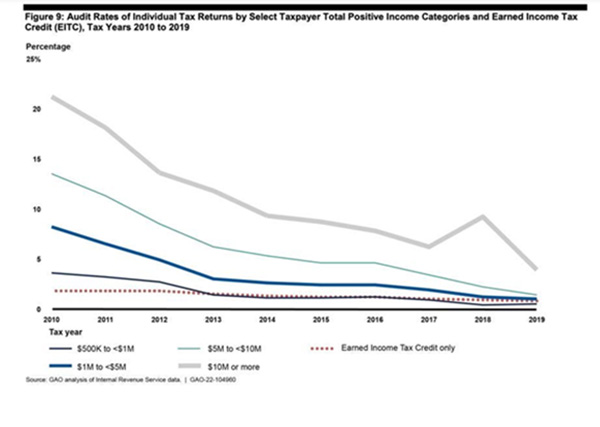
The rate at which the IRS is auditing individual taxpayers has declined overall between the years of 2010 and 2019 (2020 data is too new and 2021 returns are still being filed through the extension period). According to the Government Accountability Office (GAO), nearly 1 percent of all taxpayers were audited in 2010 compared to only 0.25 percent for the tax year 2019. The GAO chart below shows the ski slope-like drop in individual tax audit rates over the period.

IRS is Auditing

Table #3 from the GAO Report

While the IRS continues to audit higher earning taxpayers more often overall, during the 10-year period audit rates consistently declined for all levels of taxpayers, except those with the highest incomes. The audit rate for taxpayers with income between $200k and $500k experienced the largest drop, with the audit rate declining from 2.3 percent down to 0.2 percent; a 92 percent reduction in audits. Taxpayers with the highest incomes, defined as $10 million or more, saw a resurgence in audit rates from 2017-2018; however, even they experienced an overall decline, dropping from 21.2 percent in 2019 to only 3.9 percent in 2019 – equating to an 81 percent decline.

Impact on the Treasury

There is the theory that the prospect of a tax audit leads to greater voluntary compliance. In other words, if people think they won’t get audited, then they are more likely to cheat on their taxes.

Non-compliance with tax laws and regulations have a material impact on the Treasury. According to the IRS, it is estimated that on average, individual taxpayers under-reported nearly $250 billion a year for the period 2011-2013. This obviously leads to the non-collection of taxes that are otherwise owed the government and raises issues of fairness for taxpayers who are playing by the rules.

Why the Decline in Audit Rates?

One of the main drivers is a lack of resources at the IRS, a combination of both reduced funding and less auditors on staff. The number of agents working for the IRS has declined across the board since 2011. Tax examiners, the type who handle basic audits by mail, have dropped by 18 percent. Meanwhile, revenue agents, who handle the more complex cases in the field, declined by more than 40 percent over the same period.

Demographics point to an increase in these trends as there are a wave of coming retirements in the IRS. Over the next three years, nearly 14 percent of current tax examiners and 16 percent of revenue agents are expected to retire. Stack on top of this the fact that the inexperience of newer agents and the time to complete audits is also taking longer.

Conclusion

The IRS claims it is missing out on millions in legally due tax revenues due to the inability to maintain enforcement. They say they need more funding to hire more agents to perform more audits, which not only find fraud in the audits themselves but also increase overall compliance due to the pressure this creates.

Currently, there is no political focus on bringing major new resources to the IRS, so it’s not likely to see an uptick in individual tax audit rates anytime soon. The trend of focusing on the highest earners, however, will likely continue as this is where the IRS can find the most bang for its buck.

Tax Break for Commercial Real Estate Investors

Tax Break for Commercial Real Estate InvestorsCOVID-19 impacted the economy dramatically and commercial real estate was no exception in terms of decreased values. Often, the real property could no longer service the debt used to finance it. This debt restructuring and resulting debt forgiveness can result in taxable income.

Taxable Income and Debt Cancellation

If you have a $80,000 loan and the bank reduced the amount you owe down to $50,000, then you have an economic benefit of $30,000, which should be treated as taxable income. This is indeed how cancellation of debt is treated, but there are exceptions such as in the case of bankruptcy or insolvency. There is another unique scenario that applies only to commercial real estate.

Assuming that the taxpayer is not a C-corporation, debt cancellation is excludable from taxable income if it results from qualified real property business indebtedness (QRPBI). QRPBI is debt taken on to buy real property used for commercial purposes. Starting in 1993, debt used for building or improving a property also qualify.

As we all know, there is no such thing as a free lunch. In order for debt cancellation to not be considered current taxable income, the taxpayer must reduce their basis in the real property by this same amount. This does not cancel the income; instead, it defers its recognition and helps cash flow as a result. Below, we look at an example of how this works.

Illustrative Example

Assume David bought a property in 2017 and he uses it for business purposes. In 2022, the property has a first mortgage of $200,000 and a second mortgage of $100,000 (both with the same bank), with a fair market value (FMV) of $240,000. He negotiates with the bank to reduce the second mortgage down to $20,000, resulting in income from the cancellation of debt of $80,000.

The amount of debt cancellation that can be deferred is equal to the amount of the second mortgage before the debt cancellation, less the FMV minus the first mortgage. In David’s case, before debt cancellation, the FMV ($240k) minus the first mortgage ($200k) was $40,000. The balance of the second mortgage ($100k) exceeded this by $60,000. Out of the total debt cancellation of $80,000, this $60k is subject to deferral, with only the remaining $20,000 reported as immediate taxable income.

The $60,000 is not considered as taxable income only to the extent that David has sufficient adjusted tax basis in the depreciable real property to absorb this as a reduction in basis. Assuming this is the case, the reduction in basis applies the first day of the tax year after the debt cancellation (unless the property is sold before year-end – then it applies immediately).

In the example above, David would include the $10,000 of cancellation of debt income on his 2022 tax return and adjust his basis in the real property by $60,000 as of Jan. 1, 2023.

Filing Mechanics

For real estate held via partnerships instead of by individuals, determining if debt is QRPBI qualified happens at the entity level, although reductions of basis are done at the individual level for each partner, allowing individual planning. The election to defer cancellation of debt income is recorded on Form 982.

Conclusion

The COVID pandemic caused many real estate investors to restructure their debts. The option to defer debt income cancellation offers a great tax planning opportunity by delaying taxable income and improving cash flows.